


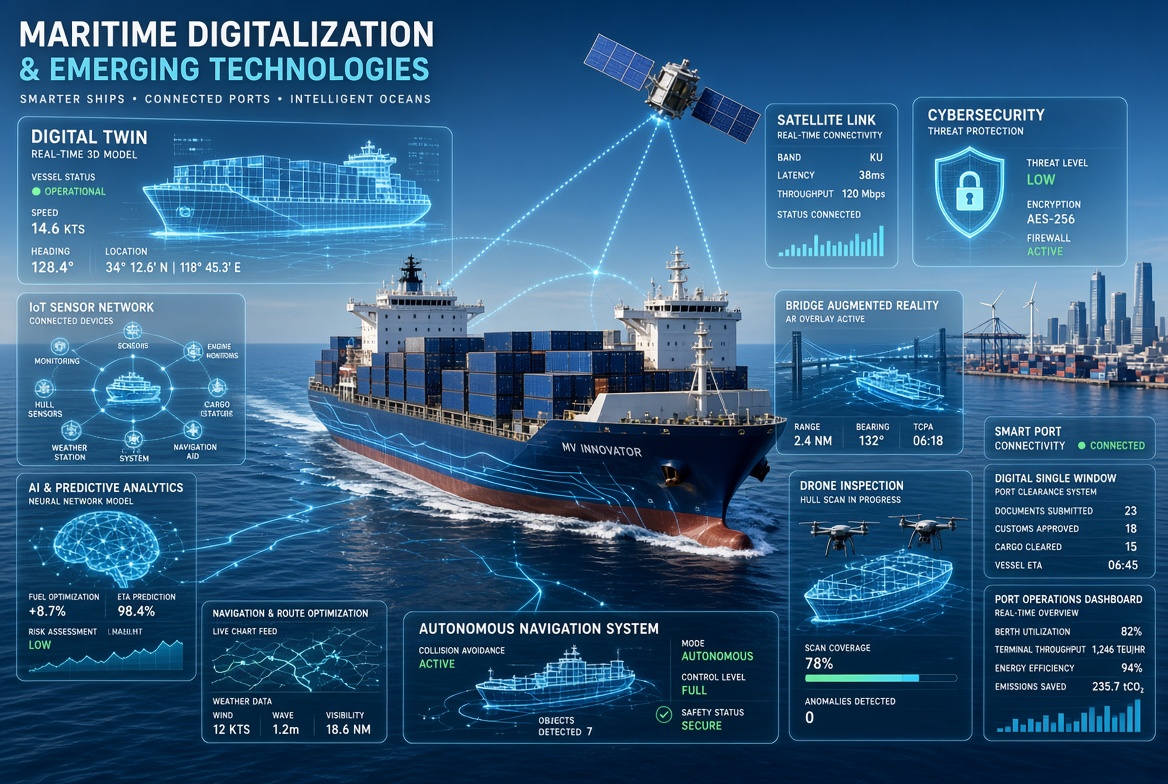
The maritime industry is undergoing significant technological change as shipping companies increasingly use digital systems to improve efficiency, safety, communication, and decision-making. Modern vessels generate and exchange large amounts of information through navigation systems, machinery monitoring equipment, cargo systems, communication technologies, sensors, and shore-based platforms. Understanding how this information is collected, transmitted, processed, and used is becoming increasingly important for maritime professionals.
Digitalization is changing the way ships and logistics operations are planned and managed. Tasks that previously depended heavily on paper records, manual calculations, or isolated systems can increasingly be supported by digital tools. Voyage information, machinery condition, cargo data, weather information, port schedules, fuel consumption, and operational reports can be integrated into systems that provide personnel with faster access to useful information.
This course introduces the fundamental concepts behind digitalization and emerging technologies in shipping. It examines connected ships, operational data, interoperability, the Internet of Things, sensors, data acquisition, communication networks, and cloud computing. These technologies form many of the building blocks of modern digital maritime operations.
The course also emphasizes that technology is not useful simply because it is available. Its value depends on the quality of the information collected, the reliability of the systems involved, the ability of different systems to communicate, and the ability of maritime professionals to interpret and use the resulting information correctly. Human knowledge and professional judgment remain important parts of effective digital operations.
By completing this course, learners will gain a foundation for understanding how emerging technologies are being applied throughout maritime transportation and logistics. This knowledge can support further study in smart shipping, maritime digitalization, vessel performance management, predictive maintenance, logistics systems, automation, and other technology-driven areas of the maritime industry.


